
Why Most AI Pilots Stall (And It Has Nothing to Do With the AI)
Zay Nadali
Why Most AI Pilots Fail to Deliver
Every week, another platform promises AI agents in minutes, unlimited automation and workflows that anyone can build. The technology is genuinely impressive, and it can already support enquiries, qualification, CRM updates, customer service and large parts of a commercial process. Yet many businesses still struggle to turn that capability into meaningful results.
The pilot begins well. A workflow is demonstrated, the team is impressed and there is a sense that the business has found a faster way to operate. Then, after the initial excitement, usage slows. The outputs become inconsistent, the team starts checking everything manually and the system gradually loses momentum.
The assumption is usually that the AI was not good enough. More often, the problem is that the business launched the technology without building the operation around it.
Most AI pilots do not fail because the technology cannot perform the task. They fail because the workflow was never designed properly around the business.
Buying AI is not the same as implementing it
Choosing a platform can feel like the biggest decision, but it is only the beginning. Building a simple workflow is relatively easy. Building one that works consistently with real customers, real data, internal rules and existing sales processes is far more complex.
The system needs to know what it is trying to achieve, which information it can trust, what it is allowed to do and when a person needs to step in. It also needs to understand how the business already operates.
A lead qualification workflow, for example, is not successful simply because it can ask questions and produce a score. It may also need to recognise product interest, check whether the prospect is already an account, apply territory rules, follow approved communication boundaries and route the opportunity to the correct representative.
The visible interaction may look simple. The operational design behind it is not.
Most businesses start with the wrong question
The conversation often begins with, “How can we use AI?”
That usually leads to teams looking for tasks they can automate rather than identifying the problem they actually need to solve.
A better question is, “Which commercial outcome are we trying to improve?”
Perhaps enquiries are taking too long to reach the right person. Follow-up may be inconsistent, CRM information may be incomplete or too many existing accounts may be receiving limited attention. The business may want to recover dormant customers, increase qualified meetings or reduce the administrative work placed on its sales team.
Each of those outcomes requires a different workflow. Without a clear objective, almost any activity can be made to look successful. A system may generate hundreds of emails, update records and trigger workflows, but none of that proves it improved the business.
Automating a task does not fix the whole process
A common mistake is adding AI to one part of an existing process without looking at everything around it.
A business may automate an outbound email but leave account selection, ownership, follow-up timing and CRM visibility disconnected. It may add an AI assistant to inbound enquiries without deciding which questions it can answer, how opportunities should be qualified or when the conversation needs to be escalated.
The individual task becomes faster, but the wider process remains fragmented.
This is why an impressive demonstration does not always become a valuable deployment. A demonstration only needs to prove that the AI can complete a task. A live system needs to prove that the task improves what happens before and after it.
The value is not in the AI completing an action. The value is in the right action happening, with the right context, at the right time.
AI is not a set-and-forget tool
Many businesses expect an AI workflow to perform perfectly from the day it is launched. In reality, even a carefully designed system will encounter new questions, incomplete records, unusual customer situations and business rules that were not obvious during the initial build.
Products change, teams change and commercial priorities shift. Customer behaviour evolves and new exceptions appear. The workflow needs to evolve with them.
That means reviewing how it behaves, identifying where the outputs are weak, updating the information it relies on and improving the decision logic over time. It also means looking beyond whether the AI completed its action.
If an enquiry was qualified and routed, did the representative respond? If a dormant account was identified, did the communication create renewed interest? If a follow-up was sent, did the opportunity actually progress?
Without that feedback, the system may continue producing activity without creating measurable value.The technology is no longer the main bottleneck
Not long ago, the biggest question was whether AI was capable enough. Today, for many commercial use cases, the greater challenge is the business design around it.
Can the organisation provide reliable information? Are the processes clear enough to automate? Does the CRM reflect accurate account ownership and activity? Are the escalation rules defined? Does anyone know how success will be measured?
AI often exposes weaknesses that already exist. If account data is unreliable, the workflow will struggle to make reliable decisions. If territory ownership is unclear, routing will fail. If every representative follows a completely different process, it becomes difficult to build a system that works consistently.
AI does not remove the need for operational clarity. It makes that clarity more important.
Why pilots lose momentum
Most pilots lose momentum for fairly predictable reasons. The workflow does not fit naturally into the team’s daily process, success is measured by activity rather than a commercial outcome, or the system requires more manual checking than anyone expected.
In other cases, the approved knowledge is incomplete, escalation paths have not been designed or nobody remains responsible for monitoring the system once it is live. The pilot may work technically, but it never becomes something the business can depend on.
The strongest results come from businesses that treat AI as part of their operating model. They define what the system owns, what remains with the team and how performance will be reviewed. They maintain the knowledge, improve the workflow and make sure someone remains responsible for the infrastructure.

How Zeltix approaches implementation
Zeltix does not provide a platform and expect the distributor’s team to work out how to turn it into a commercial system.
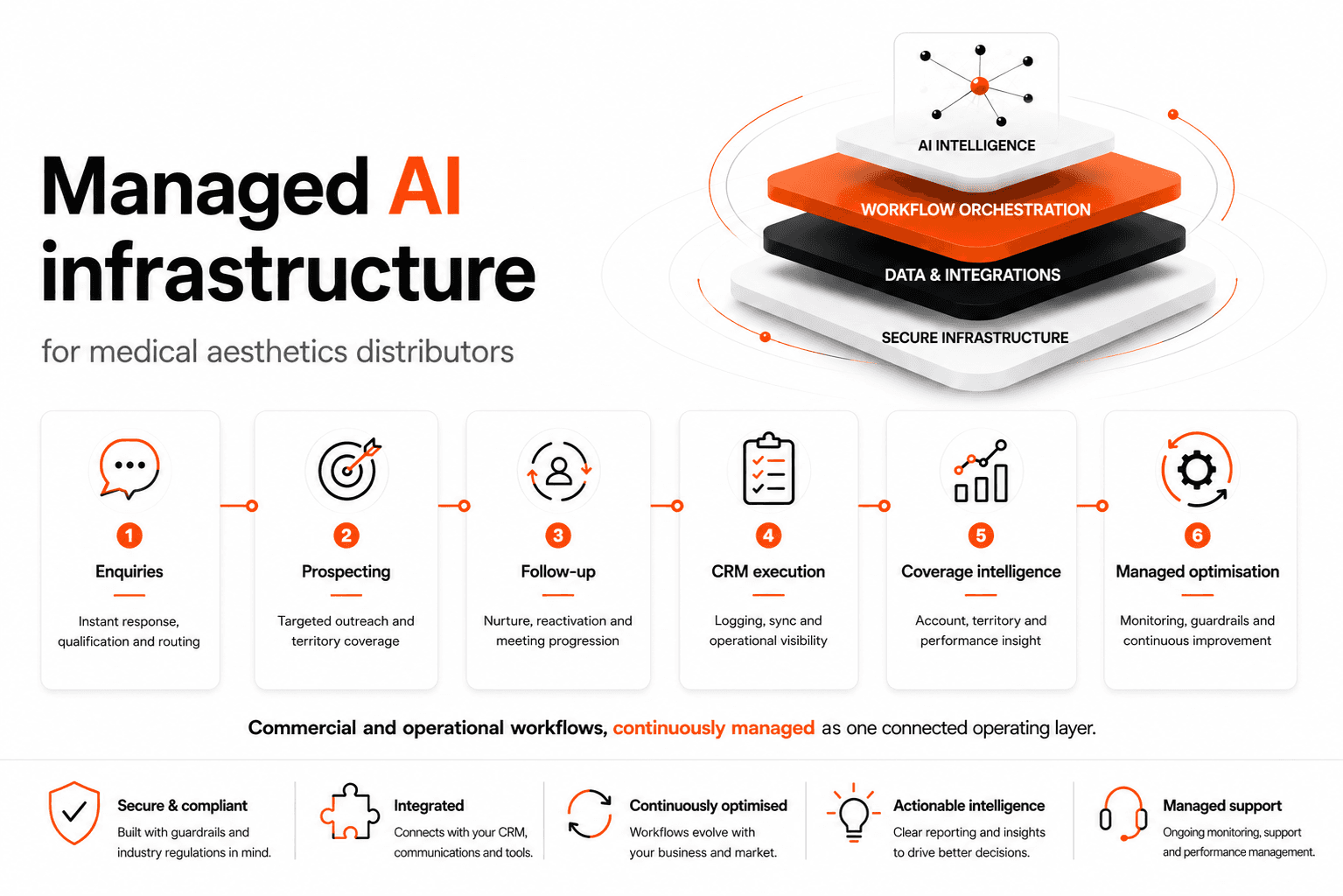
We design and manage the operating layer around the distributor’s products, territories, accounts, sales process, communication rules and existing technology. The workflows can support inbound enquiries, outbound activity, follow-up, dormant account reactivation, CRM visibility and commercial prioritisation, but they are not built as separate automations.
They operate from the same commercial understanding, with approved information, defined decision logic and clear escalation boundaries. We also remain responsible for monitoring and improving the system after deployment.
The value of an AI operation is not determined by how quickly the first workflow can be launched. It is determined by whether the system continues to perform, adapt and create measurable value once the pilot is over.
A successful pilot should prove more than capability
A pilot should not only answer, “Can the AI do this?”
It should answer, “Does this improve the way the business operates?”
That means testing the workflow with real data, real exceptions, real team structures and real commercial priorities. It should improve something that matters, whether that is response time, account coverage, follow-up consistency, opportunity progression or operational visibility.
Launching the pilot is not the achievement.
Building something the business can trust, use and continue improving is.